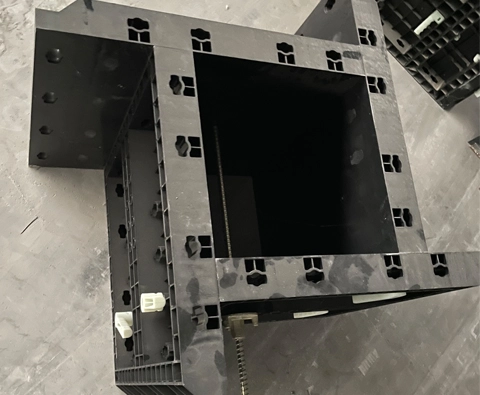
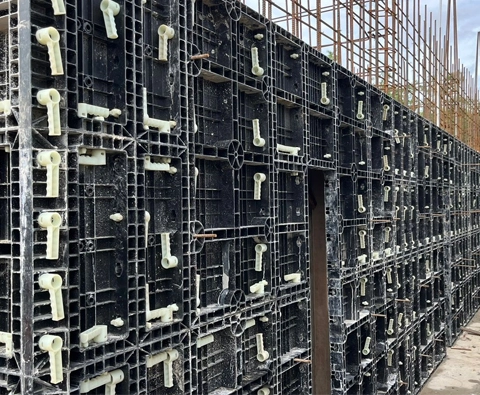
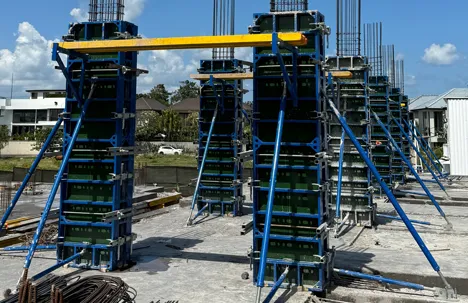
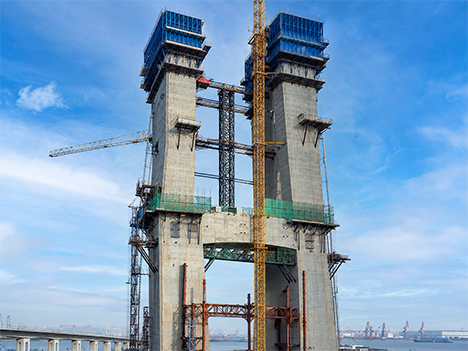
Plastic column form is a modular new formwork system commonly used for forming and supporting concrete columns. This type of formwork is made of high-strength plastic mixed with glass fiber, which is lightweight, wear-resistant, and has a high reuse rate. Compared to traditional wood and steel formworks, plastic formworks are more environmentally friendly, more efficient in construction, and more economical. They are gradually being widely used in various residential, commercial buildings, bridges, and other projects. However, during construction, to ensure structural quality and avoid deformation and grout leakage, special attention needs to be paid to some details when using plastic column forms.
Before installing the plastic column forms, an installation plan and construction sequence arrangement must be made based on construction drawings and formwork layout diagrams:
Check if the positioning reference line is accurate to ensure the construction line is correct, especially the column centerline and the formwork positioning line.
The erection sequence should start from one side of the formwork, then proceed with rebar tying. After completion, install the tie rods, and then erect the formwork on the other side. This is beneficial for symmetrical stress and stability of the formwork.
Before fixing the tie rods, calibrate the verticality and position of the formwork to ensure it matches the drawings. Adjust as needed before tightening the bolts.
Plastic column formwork generally uses a modular assembly design, and the seams must be tight during installation:
After connecting each piece of formwork, carefully check the joint position to ensure the seams fit perfectly.
Use special corner modules at column corners and seams to ensure neat edges and prevent misalignment and displacement of the formwork.
For high-rise or large cross-section columns, configure sufficient horizontal back braces and vertical supports on the formwork to enhance overall rigidity.
During construction, use levels, steel rulers, plumb lines, and other tools to monitor the verticality and the overall vertical line deviation of the formwork installation in real time. If any deviation is found, adjust it promptly.
Additionally, the following details should be considered during the formwork installation process:
The inner corners should form a closed connection with the horizontal back braces to ensure corner strength.
The formwork should not exhibit significant bulges or cracks. If damaged, it must be replaced promptly.
The formwork should be properly cured before removal to prevent structural damage due to premature formwork removal.
Select the appropriate formwork module combination based on the height of the column:
For conventional heights within 3 meters, the formwork can be assembled and formed in one piece;
For taller columns, assemble in sections and use a reinforced back brace system to ensure reasonable stress and reliability.
As an efficient and environmentally friendly modern formwork system, plastic column form is convenient to construct with excellent forming effects, suitable for the formation of various standardized concrete column structures. As long as construction details are strictly controlled during installation, the construction sequence is scientifically arranged, and the support system is reasonably laid out, construction efficiency, concrete quality, and on-site safety can be greatly improved. In the future, with the enhancement of industrialized building levels, plastic formwork will be widely promoted and applied in more fields.