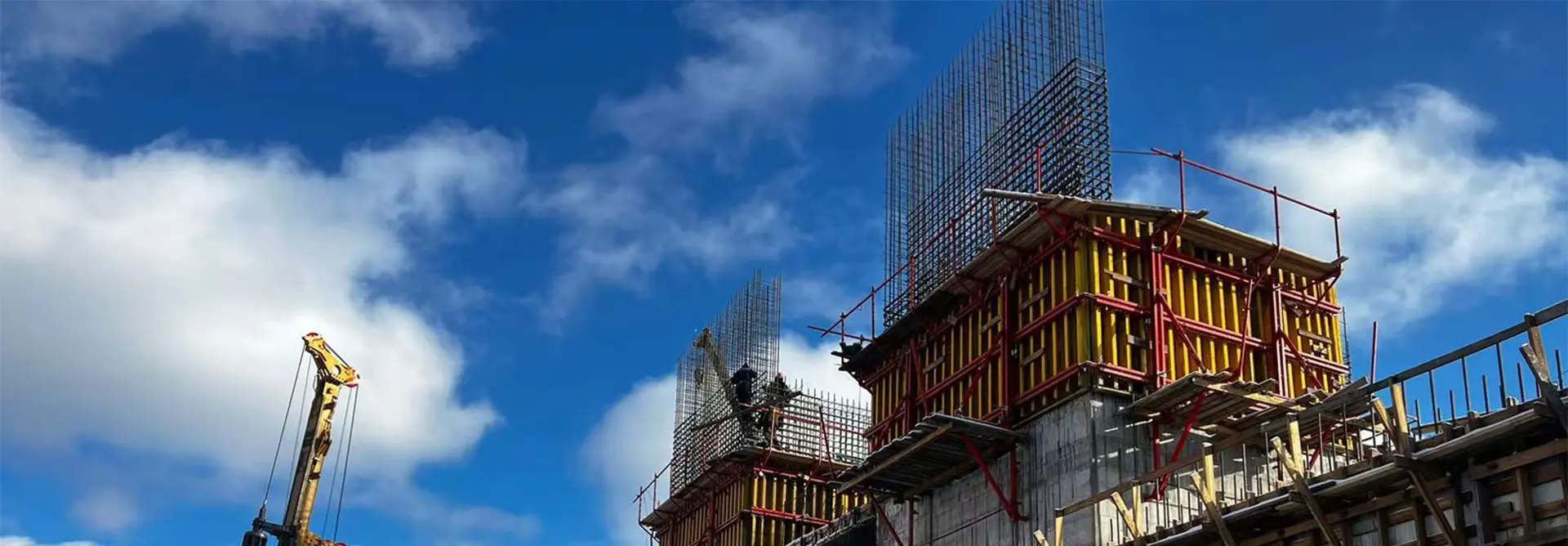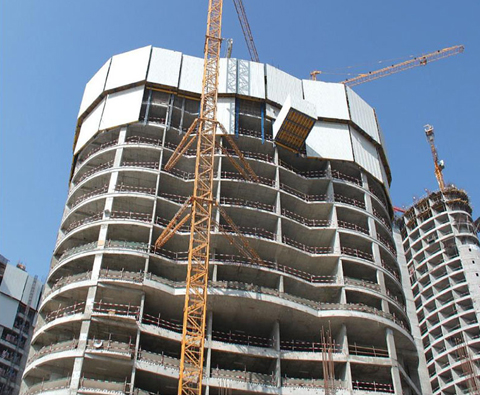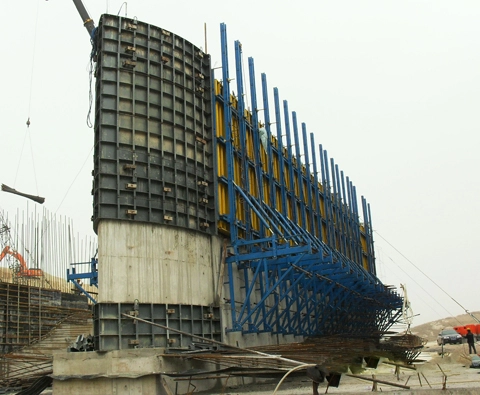
Our climbing formwork system is engineered for seamless vertical concrete placement, ensuring precision and stability throughout the construction process. We offer both Cantilever climbing formwork and hydraulic self-climbing formwork, as well as advanced auto-climbing formwork, providing versatile options for your specific needs.
As a type of self climbing formwork and self climbing formwork system, it is mainly used in the construction of vertical or large-space concrete structures such as high-rise buildings, bridge piers, and core tubes. Characterized by eliminating the need for repeated disassembly and transportation, it achieves continuous construction through the mutual climbing of climbing cone formwork and guide rails, integrating formwork, operating platforms, and protection systems to ensure both construction efficiency and safety.
Protection Screen and Unloading Platform: Focusing on protection and operating platforms, it can be shifted by crane or hydraulic means, adapting to complex building forms (e.g., inclined facades, structures with varying inclinations).
Cantilever Climbing Formwork (CB-180 and CB-240): Used in large-space concrete projects such as retaining walls, dams, and bridge piers. It bears loads via embedded anchors and wall-through tie rods, with two lifting unit types (diagonal brace type and truss type). The main platform widths of CB-180 and CB-240 are 180 cm and 240 cm, respectively.
Hydraulic Auto-Climbing Formwork: A wall-attached self-climbing system powered by a built-in hydraulic lifting system (including hydraulic cylinders and switching boxes). It supports both overall and unit climbing, with a maximum speed of 6 m/h, suitable for high piers (up to 325 m) and cable-stayed bridges.
Vertical structures of high-rise buildings, such as shear walls, core tubes, and frame columns;
Bridge projects, including bridge piers, cable-stayed bridges, straight-pier bridges, and approach bridges;
Large-space concrete projects: retaining walls, dams, tunnels, basements, and anchors;
Complex structures: straight sections, curved sections, variable cross-sections, inclined facades (±10° inclination), and super high-rise structures (up to 325 m).
Structural supports: embedded anchors, wall-through tie rods, brackets (e.g., main brackets of cantilever formwork, guide rails of hydraulic climbing formwork);
Power systems: hydraulic devices (hydraulic cylinders, switching boxes), diagonal brace-type or truss-type lifting units;
Operation and protection components: standardized operating platforms, protection screens (framed wire mesh, toe boards), ladder guards, etc..
Adjustment parts: guiding shoes, adjustable floor supports, and vertical profiles, used to adapt to structural dimensions and inclination changes.
Efficiency: Eliminates repeated disassembly, supports continuous climbing (e.g., hydraulic climbing formwork can be assembled once to the top), reduces crane usage, and saves construction time;
Safety: Equipped with full-range protection systems and operating platforms, integrated with intelligent synchronization control (e.g., automatic shutdown for over-limit conditions), reducing risks of high-altitude operations;
Adaptability: Can be adjusted to fit concrete surfaces, suitable for vertical, inclined (±10°), variable cross-section, and super high-rise (325 m) structures;
Precision: Minimizes structural errors through layer-by-layer correction, ensuring construction quality;
Cost-effectiveness: Reduces formwork damage, auxiliary material usage, labor, and equipment costs, especially economical for diagonal brace and truss types.