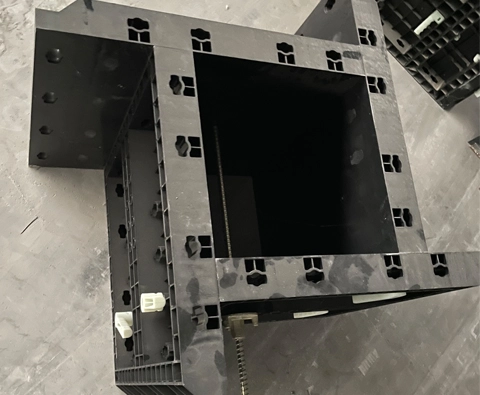
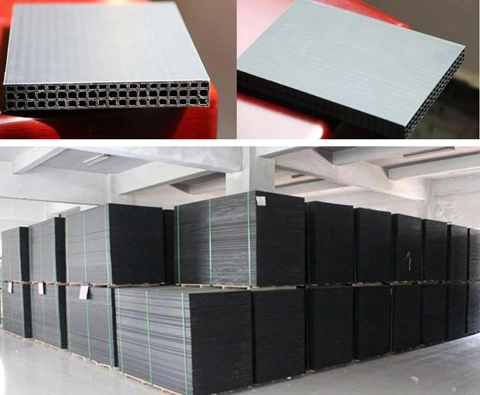
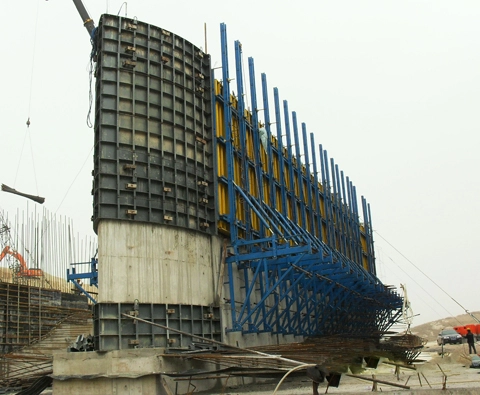
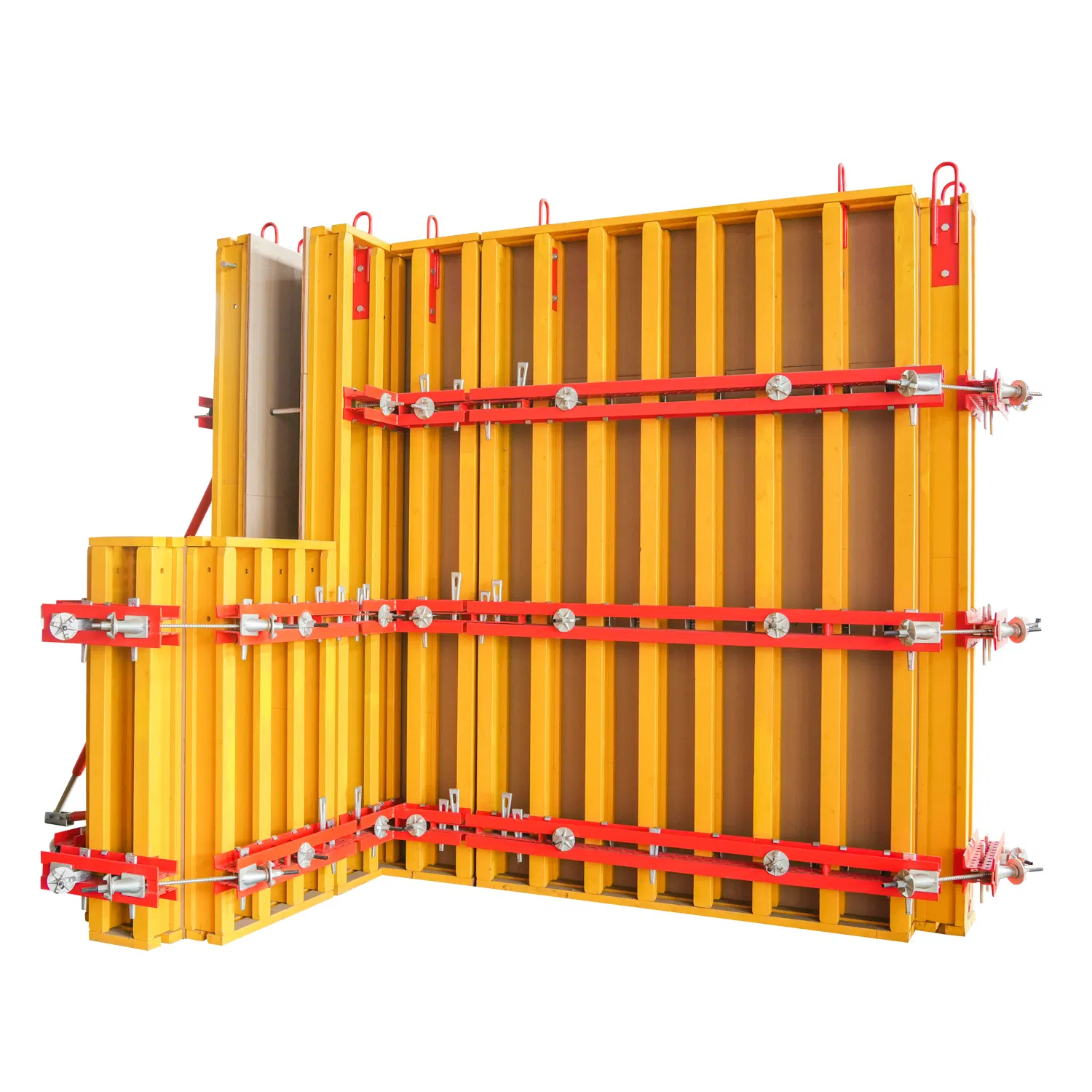
A core difference between the two in construction is weight.
Lianggong's aluminum alloy column formwork is made of 6061-T6 aluminum alloy, and the template weight indicated on the product page is approximately 23 kg/m². This system is suitable for manual handling, especially for construction environments where crane operations are limited. The allowable lateral pressure of new concrete is 60 kN/m² without using backs, and can reach up to 80 kN/m² when configured with backs.
In contrast, steel formwork is heavier, but typically has higher rigidity and deformation resistance, making it very suitable for heavy civil engineering, large structural components, and construction scenarios that emphasize formwork strength and durability.
From the perspective of industry application, aluminum alloy formwork usually has advantages in handling convenience and repetitive construction efficiency, while steel formwork is more suitable for heavy load, high-intensity formwork construction needs.
| Comparison Factors | Aluminum Alloy Column Formwork | Steel Formwork |
|---|---|---|
| Weight | Lighter | Heavier |
| Manual Handling | More convenient | Usually requires more lifting assistance |
| Installation Speed | Very suitable for fast repetitive construction | More dependent on lifting conditions and template size |
| Corrosion Resistance | Higher | Requires appropriate surface protection |
| Rigidity | Meets design load requirements | Usually higher |
| Repetitive Projects | Very suitable | Very suitable |
| Heavy Infrastructure | Can be used with reasonable design | Usually more advantageous |
For building projects with high repetition, aluminum alloy formwork often has a more obvious advantage in construction efficiency because the lighter formwork weight can reduce handling workload and speed up installation, adjustment, and dismantling.
Therefore, aluminum alloy formwork for wall column construction is particularly suitable for high-rise residential, commercial buildings, hotels, standardized residential development, and other projects with highly repetitive wall and column dimensions.
Lianggong’s modular aluminum alloy column formwork also adopts an adjustable design, suitable for column sections approximately 150 × 150 mm to 550 × 550 mm, with 50 mm as the adjustment unit.
This design can help construction units reduce the number of special templates made for different column sizes and improve the adaptability of the same set of templates in the project.
However, when the project involves super-large templates, strong on-site impact, special geometric structures, or particularly high requirements for overall template rigidity, steel formwork may be a more appropriate choice.
The lowest purchase price does not mean the lowest total construction cost.
Contractors should consider comprehensively when comparing the two types of formwork:
Initial formwork purchase cost
Estimated turnover usage times
Labor cost for installation and dismantling
Crane and lifting requirements
Maintenance cost
Repair needs
Transportation and on-site logistics costs
Lianggong product data shows that under reasonable operation and maintenance conditions, its aluminum alloy formwork frame can achieve over 300 turnover uses.
Therefore, in repetitive construction projects, the lifecycle cost of the formwork is more valuable than simply comparing the initial purchase price.
If the project has a large number of repetitive columns, reducing manual handling and lifting needs may give aluminum alloy formwork better overall economic benefits.
And if the project requires long-term use of high-strength, large-size, or highly customized formwork, steel formwork may better demonstrate its durability and long-term value.
Yes, but the prerequisite is that the formwork system must be correctly selected according to concrete lateral pressure, column size, pouring speed, and overall engineering design.
For example, the allowable concrete lateral pressure for Lianggong aluminum alloy column formwork is:
Without backs: 60 kN/m²
With backs: up to 80 kN/m²
However, construction units cannot judge whether the formwork is suitable based only on the material category such as "aluminum alloy" or "steel."
Formwork design should also comprehensively consider factors such as the lateral pressure of new concrete, pouring height, concrete temperature, pouring speed, vibration method, template combination form, tie rods, backs, and support systems.
Usually, aluminum alloy formwork has the advantage.
The lower template weight can simplify the transfer of templates between different pouring areas and reduce dependence on large lifting equipment.
This advantage is particularly evident in the following construction environments:
Basement construction
Renovation projects
Urban projects with crowded sites
High-rise buildings where crane usage time needs to be strictly controlled
Although steel formwork is heavier, when the project has good lifting conditions, the formwork can also be combined into large units, lifted and transferred as a whole by cranes, thus improving construction efficiency.
Therefore, in the actual selection process, the weight of a single formwork should not be compared alone; it should be evaluated in conjunction with the on-site logistics and lifting plan of the entire project.
There is no absolute superiority or inferiority between aluminum alloy formwork and steel formwork; the key lies in specific project conditions.
When the project emphasizes lightweight handling, fast repetitive construction, adjustable column size, reduced crane dependence, and high formwork turnover times, aluminum alloy column formwork can be prioritized.
When the project emphasizes high rigidity, heavy load performance, large-size customized formwork, and complex infrastructure construction, steel formwork is usually more suitable.
For wall column construction projects with high repetition, well-designed aluminum alloy formwork can achieve a good balance between construction efficiency, durability, and lifecycle cost.
Before determining the final formwork plan, contractors should provide column size, concrete lateral pressure, expected repetition times, crane conditions, and target construction cycle information to the formwork supplier for targeted system design.
Not necessarily. The advantages of aluminum alloy formwork usually lie in easier handling, higher reuse rates, lower labor demand, and less lifting cost, not just the initial purchase price.
Both types of formwork can achieve high turnover times with proper use and maintenance. Actual lifespan depends on construction operations, cleaning, storage, concrete conditions, and maintenance quality.
Steel usually has higher rigidity, but aluminum alloy formwork with reasonable engineering design can also safely withstand high concrete lateral pressure within its design parameters.
Yes. Lianggong's adjustable aluminum alloy column formwork can cover column sections approximately 150 × 150 mm to 550 × 550 mm, with 50 mm as the adjustment unit.
For high-rise buildings with high repetition, aluminum alloy formwork has a significant advantage due to its light weight and fast construction cycles; for heavier or highly customized structural components, steel formwork still has important application value.