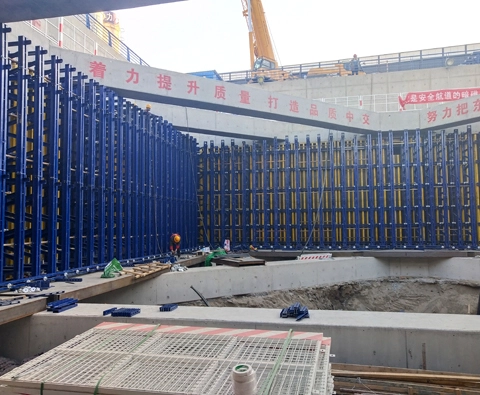
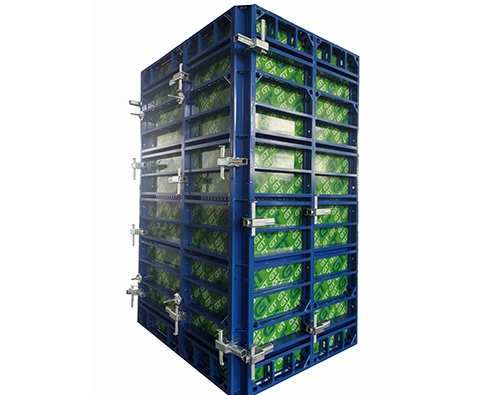
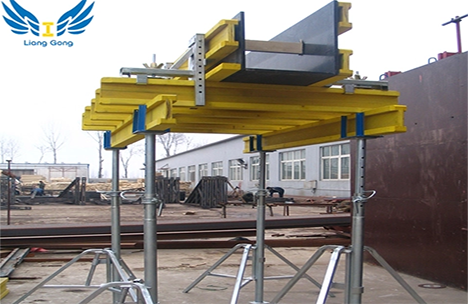
Its core advantage is not merely in reuse, but more importantly, it integrates recycling rotation, convenient on-site transportation, and standardized installation, greatly enhancing construction practicality.
Lianggong's largest specification of 1200 × 600 × 75 mm plastic panel weighs about 9.8 kg, while smaller-sized templates weigh even less.
This allows construction personnel to more easily transport and position the templates, reducing reliance on lifting equipment.
For multi-story buildings and construction sites where crane usage is limited or space for material transportation is restricted, this lightweight advantage is particularly noticeable. Compared to heavier template systems, plastic templates are generally more conducive to increasing installation speed and reducing the labor burden of transportation.
Plastic beam slab templates come in various modular sizes, allowing construction parties to flexibly pair and combine according to beam widths, slab edges, and other structural dimensions.
This is especially crucial for standard layers or repetitive structure projects: construction teams can directly use already shaped template combinations without the need to cut and modify templates on-site before each pouring operation.
Concrete residue and template cleaning time directly affect the turnover speed of templates.
Lianggong's plastic beam slab templates feature an easy-to-dismantle design, and the plastic surface has low adhesion to concrete, helping reduce the difficulty of dismantling.
After removing the templates, they can be directly washed with clean water, quickly preparing them for the next concrete pouring.
Yes, but the template system must be reasonably designed according to the actual concrete load, beam dimensions, slab thickness, support spacing, and construction sequence.
A qualified beam plastic template system must not only form the required concrete structure shape but also work together with supports, columns, locking components, and template seams to safely bear construction loads before the concrete reaches sufficient strength.
In the product parameters of Lianggong plastic beam slab templates, the system's load capacity can reach up to 60 kN/m², and it offers various specifications of template panels for modular combination.
Before selecting a system, construction units should confirm the following information:
Beam width and height
Slab thickness
Floor height
Concrete load requirements
Support pole spacing
Repetitive degree of structural dimensions
Target dismantling cycle
Openings and irregular slab areas
These factors determine whether modular plastic templates have better construction efficiency compared to wood templates, plywood templates, aluminum templates, or other slab template systems.
When the building structure has high repetition, plastic templates can often maximize construction advantages.
Typical applications include:
Apartment buildings
Hotels and dormitories
Affordable housing
Schools
Commercial buildings
Standardized residential development projects
Small to medium repetitive concrete beam slab structures
Plastic templates are characterized by being lightweight, reusable, and modular, making them particularly suitable for repetitive concrete construction and helping improve template installation efficiency.
However, if the project has a large number of irregular structures or significant structural changes between floors, a comprehensive comparison between plastic templates and wooden beam templates or custom template systems should be conducted before final selection.
In projects with high repetition of use, plastic templates are often more economical.
Plywood may have lower initial material costs and is easy to cut on-site, suitable for handling special shapes. However, when plywood repeatedly becomes damp, is damaged during dismantling, or requires frequent replacement, its comprehensive usage costs can quickly increase.
In contrast, plastic templates have good waterproof performance and are specifically designed for multiple reuse.
Therefore, a more reasonable cost comparison method should be:
Comprehensive cost of templates per effective pouring = Purchase cost + Labor cost + Maintenance cost + Cleaning cost + Replacement cost + Transportation cost
For projects with high repetition, even if the initial purchase price of plastic templates is higher, their lower replacement frequency and higher transportation efficiency can still make the overall cost more competitive.
When comparing different beam slab template manufacturers, procurement personnel should not just compare template unit prices.
Experienced template manufacturers should be able to analyze beam slab dimensions based on project structural drawings and provide reasonable template combinations, support arrangements, connection methods, and template quantity suggestions.
It is recommended to focus on the following when purchasing:
Template materials and durability
Available modular sizes
Locking connection systems
Load capacity parameters
Accessory and spare part supply capability
Ease of cleaning and maintenance
Engineering technical support
Packaging and international transport capability
Compatibility with support poles and accessories
Lianggong offers various specifications of plastic template panels and uses nylon handles to connect and lock the templates, improving on-site installation efficiency.
Reusable plastic beam slab templates are particularly suitable for concrete construction projects requiring lightweight, modularity, and high reuse efficiency.
Their practical advantages include easier manual transportation, rapid template connection, simple dismantling operation, direct water cleaning, and reducing the need for repeated on-site wooden template fabrication.
For residential and commercial building projects with high repetition, these features help improve template turnover efficiency and reduce labor and template replacement costs during multiple pours.
Before determining the template system, construction units should provide template manufacturers with information such as beam dimensions, slab thickness, floor height, concrete load requirements, and the number of repetitive constructions to allow manufacturers to design a more reasonable template configuration plan.
Yes. High-quality plastic templates can be reused multiple times with correct use, cleaning, and storage.
Yes. Plastic templates have good waterproof performance and will not absorb large amounts of moisture like traditional plywood.
Yes. As long as supports and poles are correctly configured, modular plastic templates can be used for beam and slab construction.
Lianggong's plastic templates can be quickly cleaned with clean water after removal.
Projects with a large number of repetitive beam slab dimensions are most suitable, such as apartments, hotels, dormitories, and standardized residential buildings.