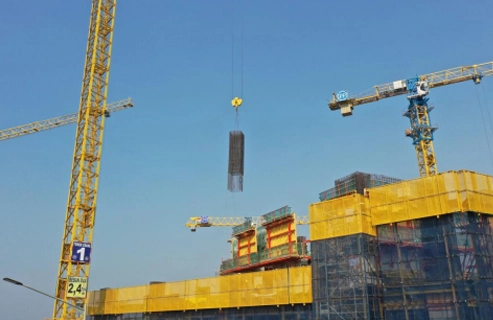
The H20 timber beam column formwork, compared to traditional on-site fabricated column formwork, mainly differs in terms of structural design, load-bearing capacity, adjustability, reuse efficiency, and concrete forming effects.
The H20 timber beam column formwork system is mainly composed of H20 timber beams, plywood, steel walers, and standardized connectors.
Traditional column formwork is usually assembled on-site using plywood, timber, and support components.
For projects requiring repeated column casting, variable column cross-section sizes, or high requirements for concrete surface quality, H20 timber beam column formwork usually provides higher construction efficiency and more stable quality control. However, for smaller projects, simple structures, or one-time use, traditional wooden formwork still has certain cost advantages.
| Comparison Factors | H20 Timber Beam Column Formwork | Traditional Column Formwork |
|---|---|---|
| Structural Support | Engineered system composed of H20 timber beams + steel walers | Ordinary timber and on-site support |
| Adjustability | High, can adjust the formwork according to different sizes | Usually requires on-site cutting and remaking |
| Reusability | Suitable for multiple turnovers | The number of uses is influenced by the condition of timber and plywood |
| Assembly Method | Standardized components, more regulated installation | More on-site processing, higher labor input |
| Concrete Forming Effect | More stable surface quality when used correctly | Heavily reliant on the skill level of construction personnel |
| Applicable Projects | Repeated construction, medium to large projects | Small or one-time projects |
H20 timber beam is a standardized formwork load-bearing component with a good strength-to-weight ratio. Compared to ordinary timber with inconsistent on-site dimensions, H20 timber beams, when used with steel walers and suitable plywood, can more stably and controllably withstand the lateral pressure generated by freshly poured concrete.
This advantage is particularly evident in repetitive column construction.
When the formwork moves from one column to another, construction personnel do not need to recreate an entire set of formwork each time; they can adjust the formwork to fit the new column size, thus reducing on-site work and improving construction efficiency.
Lianggong's H20 timber beam column formwork can be configured according to different column heights and cross-sections, and all modular components can be reused, making it especially suitable for repetitive concrete pouring operations.
Generally, H20 timber beam column formwork is more likely to achieve stable concrete forming effects.
Its timber beam and steel waler system can provide stable support for the panels during pouring, reducing problems such as formwork deformation and surface unevenness, effectively minimizing after-sales issues.
However, the final concrete surface quality is still influenced by various factors, including:
Plywood quality
Sealing condition of formwork joints
Release agent application method
Concrete pouring method
Vibration quality
Traditional wooden formwork can also achieve good concrete surface effects but usually relies more on the processing precision of on-site carpentry and the actual condition of the timber and plywood.
From the perspective of initial procurement cost, the investment in the H20 timber beam column formwork system may be higher than directly purchasing ordinary timber and plywood to make traditional formwork.
However, for actual projects, a more valuable reference metric is usually not the initial purchase price, but the comprehensive formwork cost per pour.
In repetitive construction projects, H20 timber beams, steel walers, and related accessories can be used for multiple turnovers, allowing the procurement cost to be spread over multiple construction cycles. Additionally, higher formwork reassembly efficiency also helps reduce the labor cost required for on-site cutting, reprocessing, and formwork adjustment.
If a project only involves a small number of simple columns with little to no reuse demand, then traditional column formwork might remain the more economical choice.
H20 timber beam column formwork is particularly suitable for the following types of projects:
A large number of columns with the same or similar sizes
Inclusion of columns of different sizes, such as square or rectangular columns
Taller columns or larger cross-section sizes
Frequent formwork turnover required
High accuracy requirements for column dimensions
Requirements for fair-faced concrete surface effects
Projects that emphasize formwork turnover speed and construction efficiency
For contractors requiring international procurement, a professional timber beam column formwork exporter should not only provide formwork products but also have the capability for formwork configuration, H20 timber beam spacing design, accessory selection, packaging and transportation, and project technical support.
When selecting H20 column formwork, you should not only consider the column dimensions but also comprehensively evaluate multiple engineering parameters.
It is recommended that purchasers provide the formwork supplier in advance with:
Column height
Column cross-section size
Expected concrete lateral pressure
Concrete pouring speed
Type of concrete
Surface quality requirements
Lifting conditions
Expected formwork turnover times
The supplier can determine the reasonable spacing of H20 timber beams and steel walers and the overall formwork configuration based on these parameters.
Especially in projects with high columns, large cross-section columns, or rapid pouring, a reasonable formwork stress design is crucial.
Compared to traditional on-site fabricated wooden formwork, H20 timber beam column formwork is a more systematic, engineered, and reusable column formwork solution.
Its main advantages include a standardized load-bearing structure, flexible size adjustment, high reuse rate, higher assembly efficiency, and more stable concrete forming quality.
For simple structures and limited construction quantities in one-time projects, traditional wooden formwork still has certain advantages. However, for projects involving a large number of repetitive columns and emphasizing construction efficiency and concrete surface quality, using the H20 timber beam formwork system can generally provide better long-term economic benefits.
Lianggong can provide H20 timber beam column formwork solutions tailored to different column sizes and project requirements, helping contractors achieve a more reasonable balance between formwork load-bearing performance, construction efficiency, and reuse rate.
H20 timber beam column formwork is a modular concrete column formwork system typically composed of H20 timber beams, plywood, steel walers, tie rods, and connecting accessories.
Yes. As long as it is used, cleaned, and maintained correctly, its main structural components can be reused multiple times.
Yes. By adjusting the configuration of timber beams, panels, and related components, it can adapt to different column sizes within the system design's allowable range.
For projects with repetitive construction, significant size changes, and high requirements for concrete surface quality, H20 formwork is usually more efficient. For simple one-time projects, traditional wooden formwork may be more economical.
It is recommended to provide information such as column size, height, concrete lateral pressure or pouring conditions, surface quality requirements, project quantity, and expected turnover times, so that suppliers can offer a more suitable formwork configuration plan.