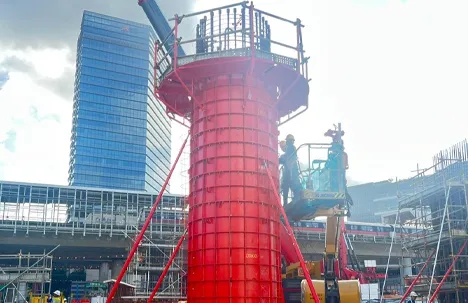
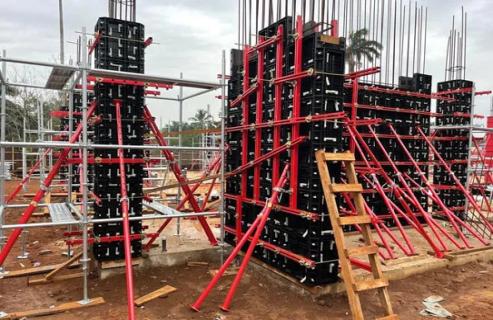
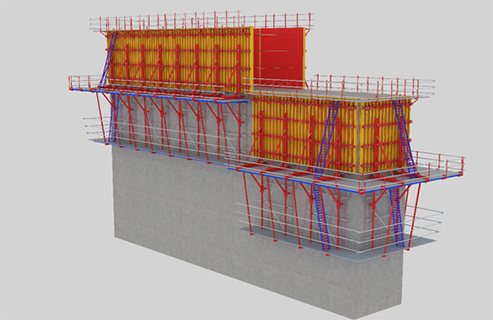
Complex geometric shapes are one of the most common reasons for using custom templates.
Typical applications include:
Curved or irregular concrete structures
Variable section bridge piers
Domes and architectural modeling structures
Special stairs
Tunnel lining sections
Non-standard shear walls
Large prefabricated concrete components
Structures with continuously changing sections
If a large number of standard templates are used to assemble these structures, it often requires many supplementary panels, wooden fillers, joints, and on-site adjustments.
In comparison, custom steel template systems can be directly processed and manufactured according to the geometric shape of the target structure.
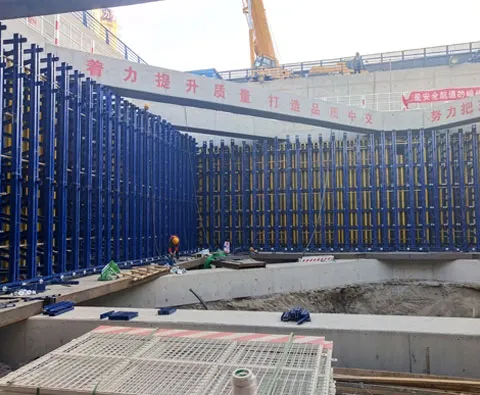
Lianggong's custom steel templates can be applied to tunnel linings, bridge piers, dams, shear walls, stairs, domes, prefabricated component factories, and other special structural engineering.
In non-standard structures, custom templates typically have a more notable advantage in dimensional accuracy.
Steel itself has a high rigidity, and custom steel templates can be manufactured according to determined dimensions and contours, allowing for better control of the geometric shape of the concrete after forming, and reducing dimensional deviations caused by extensive on-site splicing and transition components.
This precision is particularly important for the following projects:
Prefabricated component assembly
Bridge line control
Fair-faced concrete appearance
Mechanical equipment interfaces
Repeated production of identical special-shaped components
For ordinary rectangular walls, this level of customization may not be necessary; but for complex bridge piers or high-precision prefabricated components, custom steel templates are often crucial.
Custom templates usually require more investment in design and processing in the early stages.
But if the same set of templates can be reused, or if the customized design can significantly reduce on-site labor, then this type of investment is easier to reflect economic value.
When comparing costs, you can refer to:
Single pour template cost = Design and manufacturing cost + Installation labor + Lifting fees + On-site transformation + Maintenance + Concrete repair cost ÷ Number of uses
In the following situations, custom templates usually have an advantage:
The same type of special-shaped components need to be poured repeatedly
Standard templates require extensive on-site modifications
Concrete repair and post-processing costs are high
Project has strict dimensional tolerance requirements
Template installation speed affects the overall project schedule
The same set of molds can be reused for multiple pour cycles
Lianggong's steel template system adopts high-strength steel structures and emphasizes modular installation and reuse, so during multiple pours, the initial customization costs can be amortized through durability and high construction efficiency.
Yes, and often this method is the most economical.
A project does not necessarily need to use all custom templates.
Standard templates can continue to be used for regular areas, while custom steel templates are used only in parts with special geometric shapes or high structural requirements.
For example, in bridge pier construction, some supports and connectors can use the standard system, while the template panels that truly determine the shape of the bridge pier can be specially processed according to the contour of the pier.
This "standard + custom" combination can reduce unnecessary custom processing while ensuring the shape and accuracy of the target structure.
Yes. In fact, the higher the repeatability, the more easily custom steel templates usually reflect economic value.
Once the templates are accurately manufactured according to the target structure, construction personnel can repeatedly produce concrete components with the same geometric shape without having to remake the templates each time.
Therefore, it is particularly suitable for:
Prefabricated concrete factories
Repeated bridge pier construction
Standardized special-shaped components
Tunnel structures
Infrastructure projects with repetitive geometric shapes
Lianggong's custom steel templates combine high-strength steel structures, modular installation, reusability, and special-shaped customization, making them suitable for such projects.
The final design quality of custom templates largely depends on whether the information provided at the beginning of the project is complete.
Contractors should usually provide:
Structural construction drawings
Accurate concrete dimensions
Required dimensional tolerances
Concrete lateral pressure or pouring speed
Expected number of repeated pours
Concrete surface quality requirements
Construction joint locations
Lifting conditions
Crane capacity
Demolding direction
On-site space limitations
Target construction cycle
Professional suppliers should comprehensively assess these factors before finalizing the steel template system.
Template selection should not only consider geometric shapes but also take into account load-bearing capacity, concrete surface effects, on-site logistics, construction progress, structural dimensions, and actual working conditions.
In the following situations, standard templates are usually more appropriate:
Structure size is relatively conventional
Geometric shapes are mainly rectangular
Limited number of repeated constructions
Minor supplementary panels can solve dimensional differences
No high requirements for building appearance and dimensional tolerances
Custom processing is not economically viable
If all structures use custom templates, it may increase unnecessary design and manufacturing costs.
Therefore, the real goal is not "to customize as many templates as possible," but to use custom solutions only where customization can improve construction efficiency, dimensional accuracy, reuse rate, or overall project costs.
When a project involves complex geometric shapes, strict dimensional control, special concrete surface requirements, repeated non-standard components, or when standard templates cannot efficiently meet construction conditions, custom templates are more suitable.
Standard templates remain the priority choice for conventional concrete structures, while as the complexity of structures and the number of repeated constructions increases, the value of custom steel templates becomes more apparent.
For bridges, tunnels, dams, prefabricated components, stairs, domes, and other special structures, professionally designed custom steel template systems can reduce on-site modifications, improve dimensional consistency, simplify repeated pours, and reduce post-repair concrete work.
Before requesting a quote, contractors should ideally provide complete construction drawings, concrete dimensions, repetition numbers, surface quality requirements, and on-site lifting conditions so that template manufacturers can determine whether a full custom solution or a "standard template + custom template" combination can achieve better full lifecycle costs.
Usually, initial costs are higher, but if they can be reused multiple times and reduce on-site modifications, installation time, and concrete repair work, their overall usage cost may be lower.
Common applications include bridge piers, tunnels, dams, domes, special stairs, prefabricated components, and other irregular concrete structures.
Yes. When reasonably designed, correctly operated, and maintained, steel templates are very suitable for repeated use.
Yes. They are especially suitable for repeatedly producing prefabricated components with consistent dimensions but non-standard geometric shapes.
Yes. By combining standard templates with custom components, unnecessary custom processing can be reduced while meeting the geometric and construction requirements of special structures.